 Australia
 Canada
 Cayman Islands
 Dominican Republic
 Hong Kong
 India
India
 Indonesia
 Ireland
 Jamaica
 Singapore
 Thailand
 United Kingdom
 United States
 Vietnam

 New Zealand Business Directory
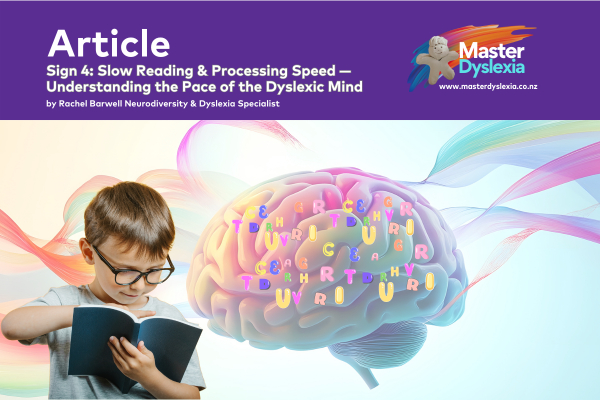
Slow Reading & Processing Speed — Understanding the Pace of the Dyslexic Mind
By Master Dyslexia Ltd · 01/23/2026
As we continue exploring the Top Five Signs of Dyslexia , I want to spend some time with a trait that many people notice early on, even if they don’t yet have the language for it. It’s the child who reads beautifully one moment and then seems to hit a wall the next. The adult who takes a little longer to process spoken instructions. The learner who needs to re-read a paragraph several times before the meaning settles. What so often gets described as “slow reading” or “slow processing” is, in fact, something far more complex, and far more human. It’s one of the clearest signs of dyslexia, and yet also one of the most misunderstood. Slow reading does not mean a lack of intelligence. Slow processing is not a lack of effort. It’s simply the way the dyslexic brain moves through the world. And when we understand this, so much begins to make sense. The True Pace of a Dyslexic Brain Reading is a layered process. For non-dyslexic readers, the steps involved, recognising words, connecting sounds, holding meaning, happen almost automatically. For dyslexic individuals, those same steps require conscious effort each and every time. It’s not that the person can’t read. It’s that their brain is working incredibly hard behind the scenes. Many dyslexic people describe feeling as though they’re decoding every single word from scratch. By the time they’ve worked through the mechanics of a sentence, their working memory may already be stretched. They understand the meaning, but the process of getting there takes more energy than anyone realises. This is why the pace is slower. Not because the capability isn’t there, but because the cognitive load is heavier. And that difference in pace can show up in more places than reading alone. Processing spoken language, instructions, even everyday conversations may take a little more time. It’s not hesitation, it’s thoughtful, deep processing that simply doesn’t happen at lightning speed. What This Can Look Like in Real Life Slow processing can present in so many subtle ways. A child may lose their place when reading or need time to think before responding. A teen might understand a topic deeply but take longer to put their thoughts on paper. An adult may pause before answering a question, not because they’re unsure, but because they’re still forming the clearest way to express it. From the outside, it can be easy to misinterpret these moments. But from the inside, these individuals are often working harder than anyone else in the room, trying to keep pace with expectations that simply don’t match the way their brain operates. There is no lack of ability here. Just a different rhythm. Why Pace Has Nothing to Do with Potential One of the biggest challenges dyslexic individuals face isn’t the slow pace itself, it’s the assumptions others make about it. We live in a world that values speed. Fast reading, fast replies, fast thinking. But speed and intelligence are not the same thing. In fact, many dyslexic minds think in ways that are far more layered, nuanced, and creative. They take time because they're processing deeply, not because they’re struggling. Some of the most insightful thinkers I’ve ever worked with move slowly, and their pace is directly connected to the richness of their ideas. When we step back and make space for that pace, everything changes. Confidence grows. Anxiety decreases. Understanding becomes clearer. The learner’s true abilities finally have room to shine. Supporting Dyslexic Learners in a Fast-Paced World One of the most compassionate ways we can support dyslexic individuals is by honouring the time their brain needs. Extra time is not a luxury, it’s a necessity. It gives the brain the breathing space required to process information without panic or pressure. Tools like audiobooks, speech-to-text, visual supports, and recorded instructions remove unnecessary barriers. They allow dyslexic learners to focus on meaning rather than battling mechanics. These tools aren’t shortcuts, they’re pathways to access. I’ve seen learners blossom simply because they were no longer expected to “hurry up.” When the pressure lifts, so does the fog. Their thinking becomes clearer, their engagement increases, and their confidence often grows ina loved ways that surprise even them. Seeing Pace Through a New Lens Slow reading and slow processing speed are not signs of inability. They’re signs of how a dyslexic brain processes information, thoughtfully, deeply, and uniquely. That difference in pace can be a strength, especially in a world that often rushes past the things that matter. When we understand this sign, we stop asking dyslexic learners to be faster. We start asking: How can we support you so your brilliance can come through? And that simple shift changes everything. If you would like to find out more about how what I do might help a loved one, or yourself, reach out at www.masterdyslexia.co.nz/let’s-talk
About This Author

Kapiti Coast, Wellington, New Zealand
More Articles From This Author
When Reading Feels Like a Mountain: The First Sign of Dyslexia

2026-01-23When reading feels like a battle, it’s easy for a child to believe they can’t do it. But what if the problem isn’t effort, it’s approach?This article explores the first sign of dyslexia: reading fluency challenges, and how meaning, not memo… Read More »